

2·
9 days agoyes thats a good idea, we actually made an FAQ that sits with our docs…I want to monitor to see if this helps people navigate some of these questions:)
yes thats a good idea, we actually made an FAQ that sits with our docs…I want to monitor to see if this helps people navigate some of these questions:)
hm…great points, thanks for taking the time to answer.
From the perspective of a user, why would they care about development speed?
Yes, the tool is already developed but it will continue evolving right? I mean, we almost make 2-3 releases every month since we shipped the first version and then open sourced. So the speed still counts. Plus, the users who create the tickets and expect them to be tackled are actually developers themselves. So yeah, the ability to deliver (at a good pace) to these folks matters a lot.
However - YES, if at some point the tool is at a state that the speed becomes less meaningful or useful, then indeed a change might be needed?
As for platform consistency, again, why would the user care?
Yes, since our users are Dev (and QA) folks, we thought that yeah, maybe someone could have different systems for work vs home vs side project (as you said). But another aspect that we thought is teams and collaboration. We didn’t want to have a scenario in which a team can not use it before some of the devs are using macs, others linux vs the QA folks using windows etc.
What I’m getting at is that the concerns of developers will not always be equally concerning to users.
Thats the heart of the discussion:) I guess because our users are also developers. :)
nice metaphor:) but unlike a car, these Electron processes aren’t slowly eating your tires or draining your oil. Maybe a better metaphor would be that the car you rent comes with a few extra cup holders you that you didn’t ask for? :)
thanks! well, the feedback and the questions did not come from lemmy per se but in general. And yes, I agree with you. People do have strong opinions and this is more a question for me - as I often feel that perhaps there is some “better” way to explain or show the impact of the decision. (and explain the trade off). But I think that ultimately you are saying one simple (but very important) thing: that you can not please everyone :)
Yeah, honestly, sometimes I feel frustrated trying to explain it, because I know some people will never be satisfied. I just want to be transparent about the tradeoffs and let people SEE the actual usage (even if it will indeed not convince everyone).

so there could be an option “select a texan taxi driver” irrespective of where you are in the world
yap…thats the thing…you never know…the interesting conversations can only happen only when we are open and ready to accept also the banal ones :)
thats super sad…I dont have a problem with someone not wanting chit chat but isnt better to just say “hey, today I am not in much mood to talk” or to show it and to make it happen without explicitly selecting it in an app…
its just very black mirror esque
we are indeed looking at the docs again. To begin with we focused on the tool itself so some of the examples that you see can indeed be worth revisiting and re writing. :) But I hope you can focus and zoom in to the tool itself and see how this can help you with your API workflows.
True. Background of the story of how I learnt is in my tai chi class where I asked the teacher if they also do king fu there. And they told me that well tai chi is also part of kung fu.

wow wow thanks! please spread the word!

awesome, thanks for sharing.
feel free to play around and tell me what you thought - especially around the reusable blocks: most devs we talk with consider this to be the most “different” thing and what is more different than other clients… For me its this one too + the plain text files all the way from specs, tests, docs, context etc…
yay - feel free to add few of these QoL tweaks here: https://github.com/VoidenHQ/voiden/issues
Hey :) Voiden is not a rich text editor (non offense to rich text editors). It is executable API docs: requests, docs, and explanations that all live in Markdown… and actually run. (Yes, your docs that do stuff). As far as I know it is the first tool to collapse design, testing, and documentation into one file, one format, one workflow. If you know another tool that does this, I genuinely want to hear about it (definitely not trying to be cocky, just curious :)
Yaak has some ideas and concepts that I like a lot. One thing that is similar with Voiden is that they are extensible through plugins. This way the core can stay lean and new functionality can be added up without bloating the app.
hey - thats great :) Happy you downloaded it :) curious to hear your feedback - I will send you a discord link as a message so its not seen as spamming.
Let me see if I understand your question: you mean how Voiden would look when its more mature?
What I am most excited about is that Voiden already does a few things differently from most API tools. Reusable blocks, plain-text everything, and the ability to go from testing to docs to publishing from a single source are already working and shaping how teams can work in a more consistent way.
There is still a lot ahead (for example I want to see what kind of plugins people come up with for the tool, or how AI will eventually play a bigger role) but the principles of Voiden (reusability, composability, plain text, collaboration through git, single source of truth etc.) are the ideas I believe will define and set a new tone/standard of how API tools should be.
I thought no one would ask :) just open sourced it a few weeks ago. But I promise I will never pay someone to praise it pretending to be a developer.
haha I dont know how to take this

yeah, do agree with part of it. Without HashiCorp Terraform, we probably wouldn’t have OpenTofu at least not in the form it exists today. In that sense, VC money did indeed help bootstrap something that eventually became broader open infrastructure.
You could argue the same happened with Elasticsearch leading to OpenSearch, or Redis eventually leading to Valkey.
So yes, venture funding can indeed accelerate the creation of useful open ecosystems.
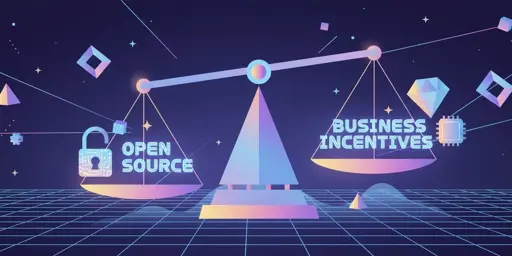
The tension I am pointing to is more about the transition phase. When a project grows under the assumption of being open community infrastructure and then the business incentives shift later, it tends to create friction: license changes, forks, community distrust, etc.
Forks are actually a feature of open source: they are like the ecosystem’s pressure valve. (But they also show that the incentives between companies and communities drifted apart at some point.)
So I would frame it less as “VC-funded open source is bad” and more as: “VC-backed projects often bootstrap great ecosystems, but the sustainability model tends to get figured out later, and that’s where things get messy.”
In some cases we end up with something great like OpenTofu. In others we end up with fragmentation and uncertainty. Both can happen.




cynically true :)