reason for them not appearing is that xmpp is a largely relaxed platform, that is, all implementations are not equally strict. some may implement certain extensions, others may implement other. encryption (omemo) is a common one that most implement, but then client (the user apps like gajim) may or may not implement them correctly, or they may have a fallback (first communication between 2 clients maybe is not encrypted), and other different problems with encryption being flaky (firstly, it is not perfect forward secrecy, it is a bit prone to failure (messages unable to decrypt), etc.), hence it is not recommended much.

he/him
Alts (mostly for modding)
(Earlier also had @[email protected] for a year before I switched to @[email protected], now trying piefed)
- 5 Posts
- 96 Comments
Joined 1 year ago
Cake day: March 14th, 2025
You are not logged in. If you use a Fediverse account that is able to follow users, you can follow this user.
 51·22 days ago
gives me a good reason to say why i do not use bash
 3·22 days ago
I am interested in it, because i have 3 package managers, arch, uv and cargo (binstall) so this covers me well hopefully.
 1·23 days ago
i rarly use it, mostly to do sentiment/grammar analysis for some formal stuff/legalese. I kinda rarely use llms (1 or 2 times a month)(i just do not have a usecase). As for how good, tiny models are not good in general, but that is because they do not have enough knowledge to store info, so my use case often is purely language processing. though i have previously used it to do some work demo to generate structured data from unstructured data. basically if you provide info, they can perform well (so you can potentially build something to fetch web search results, feed into context, and use it(many such projects are available, basically something like perplexity but open)).
pretty much this. I use smolllm (a 3B param model, trained only on openly available datasets)
further clarification - ollama is a distribution of llama cpp (and it is a bit commercial in some sense). basically, in ye olde days of 2023-24 (decades in llm space as they say), llama cpp was a server/cli only thing. it would provide output in terminal (that is how i used to use it back then), or via a api (an openai compatible one, so if you used openai stuff before, you can easily swap over), and many people wanted a gui interface (a web based chat interface), so ollama back then was a wrapper around llama cpp (there were several others, but ollama was relatively main stream). then as time progressed ollama “allegedly enshittified”, while llama cpp kept getting features (a web ui, ability to swap models during run time(back then that required a separate llama-swap), etc. also llama cpp stack is a bit “lighter” (not really, they both are web tech, so as light as js can get), and first party(ish - the interface was done by community, but it is still the same git repo) so more and more local llama folk kept switching to llama cpp only setup (you could use llama cpp with ollama, but at that point, ollama was just a web ui, and not a great one, some people prefered comfyui, etc). some old timers (like me) never even tried ollama, as plain llama.cpp was sufficient for us.
as the above commenter said, you can do very fancy things with llama cpp (the best thing about llama cpp is that it works with both cpu and gpu - you can use both simulataneously, as opposed to vllm or transformers, where you almost always need gpu. this simultaneous thing is called offloading. where some of the layers are dumped in system meory as opposed to vram, hence the vram poor population used ram )(this also kinda led to ram inflation, but do not blame llama cpp for it, blame people), and you can do some of them on ollama (as ollama is wrapper around llama cpp), but that requires ollama folks to keep their fork up to date to parent, as well as expose the said features in ui.
try to use it with llama cpp if you folks are interested in runinng locall llms - https://github.com/ggml-org/llama.cpp/issues/9181
the issue is closed, but that is not because it is solved, check it out, and find link to your relevant hardware (amd or intel or something else), and see if your particular piece is available. if so, you have hope.
in case it is not, try to find first party stuff (intel vino or intel one or amd rocm stack, and use that with transformers python or see if vllm has support).
also, try to check r/localllama on the forbidden website for your particular hardware - there is likely someone who has done something with it.
Did lennart leave microsoft? Probably a good thing in general for linux (it definitely was wierd that lead for systemd was working at microsoft)
barely booting, but that is like one of the hardest step

i feel i am going to hell for laughing on this one (not religious in case someone starts that tangent)
I personally do cc0 (though i do not have much published). i can not really be bothered to do proper licensing, and my prefered license (wtfpl) is not considered good (by admins, because it has the f word , boo hoo).
in bash if it happens, it often means i have something wrong in most recent closed loop, which may or may not have closed prorperly, somethign similar with python.

well it was not just for abuse, it basically repeated what you said in a funny high pitch voice, and there were many other small little activities it could do (based on where you touch the screen, for example a pat on head was meow, click on a sofa and it sits, there was shower, and other daily things - small but funny, and kinda very special like 12-15 years ago). I do not remember hitting it, but getting it to repeat stupid noises i make.
i had no idea about this either, thanks for telling. I have almost no idea about server stuff.
Thank you for telling that, I absolutely had no idea about that. In my mind, it has been a almost brute force reverse engineering effect, with some help from some documentation (for example, reference metal docs) or having some open source stuff for apple stuff (if that even exists).
regarding bootloader, is it not the case that bootloader just checks for signature of os, and it does not allow you to boot anything else. I did not mean that having a bootloader unlockable means having docs, but as i get it, the general approach to get android image working is to load a gsi (generic system image), if that does not work, we swap kernel or some other system stuff from available os images (which are closed black boxes mostly). now if we can not even boot a gsi (or some other android tree for lineage os), then there is no hope in running anything. and even if gsi runs, that may still have broken stuff (eg, camera or wifi, which i know are some of common culprits).
 2·1 month ago
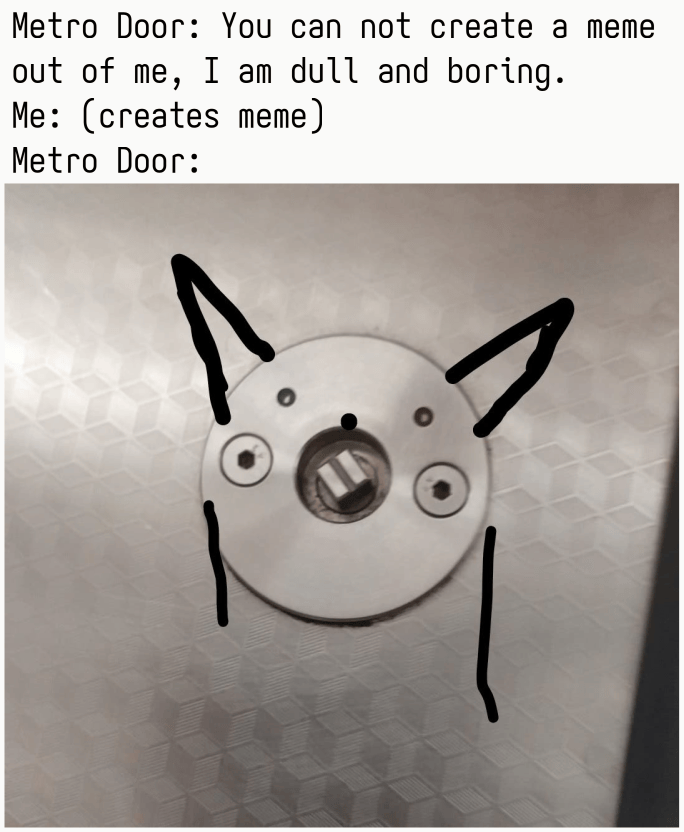
Question for mechanical/designer folks here - what do you call the middle thing exactly. i know the side cheeks are for allen keys, but what is the middle one called. I know it is meant to be used for servicing or during emergencies, and there are diagrams on the sides of door explaing how to open, but they just say mount tool and rotate, but do not name the key (or tool) or the this mount.
if i am not wrong, boot process on non x86-64 is not standardised (no obivous uefi independent of os or setup). this genuinely limits the distros one can find, and mostly first party support is all you get. when first party does linux (raspberry pi or other sbcs), it is fine, and often their boot can be “used” by other third party distros (assuming license allows that). if first party does not, there is no way to get work done. something like android - if you get first party unlockable boot lock, you can hope for custom roms, without that, its playing darts where board is invisible. with apple mac, enough people had dart boards that random trial (and recovery processes) allowed them to get in. with qualcomm stuff, there is some first party support (and some second party support from nvidia who use qualcomm cpu for their servers) but qualcomm graphics is still a issue (first party support is very slow) and not enough third party interest (not enough people have qualcomm laptops for dartboards)
it will never be 100%. there are people who use objectively superior oses (temple os)
the pfp of person is tsuchikage or rock ninja lord (who practiced tonkai land fire air i think) from naruto, whose whole shtick was that a very old person.




what does i0 even mean, like what is the sign even for