Nashville has had a machine since at least the late 60s for harvesting songs basically provided for free by writers desperate for a break, and routing them them through overproduced studios full of controllable singers even more desperate than the songwriters. Now, to be fair, the occasional gem slips through, more when the model was less refined, and then there’s folks like Dolly Parton who infiltrated it like a virus and then took it over to explode with decent music.
Still, other than what Steve Earle called “The Great Credibility Scare of the 80s” when he, Dwight Yoakam, Lyle Lovett, KD Lang, and Melissa Etheridge (among others) were allowed to bubble to the top of the scene, there’s always been a grifter business mindset that’s somehow worse in country because, as a direct outgrowth and expansion of certain varieties of folk music, audiences ask for authenticity when all they really want is cultural validation (hint: for country-adjacent music, authenticity usually looks a lot like it does in other genres). Bubblegum country therefore somehow feels dirtier than bubblegum pop, and it gets even worse as product categories ossify and Nashville country gets targeted to a more and more specific segment of the public.
I’m fully aware that even the stuff I like, the “Rockabilly [and] other various fusion efforts” broadly called “Americana,” is subject to its own tropes and business pressures, but being smaller and targeting a different niche, there’s at least room in the conversation for artistry and risk, and thankfully good music isn’t as hard to get made as some other forms of entertainment, so there’s a lot of it out there waiting to be found.
Also, nothing wrong with some nasal vocals in the right context, LOL. I do grow weary of “High and Lonesome” bluegrass vocals after about two songs, though.

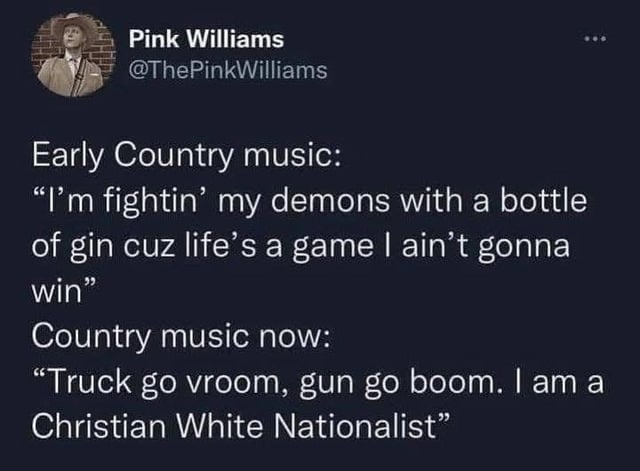
I will wax a little poetic, then. ;-)
Nashville has had a machine since at least the late 60s for harvesting songs basically provided for free by writers desperate for a break, and routing them them through overproduced studios full of controllable singers even more desperate than the songwriters. Now, to be fair, the occasional gem slips through, more when the model was less refined, and then there’s folks like Dolly Parton who infiltrated it like a virus and then took it over to explode with decent music.
Still, other than what Steve Earle called “The Great Credibility Scare of the 80s” when he, Dwight Yoakam, Lyle Lovett, KD Lang, and Melissa Etheridge (among others) were allowed to bubble to the top of the scene, there’s always been a grifter business mindset that’s somehow worse in country because, as a direct outgrowth and expansion of certain varieties of folk music, audiences ask for authenticity when all they really want is cultural validation (hint: for country-adjacent music, authenticity usually looks a lot like it does in other genres). Bubblegum country therefore somehow feels dirtier than bubblegum pop, and it gets even worse as product categories ossify and Nashville country gets targeted to a more and more specific segment of the public.
I’m fully aware that even the stuff I like, the “Rockabilly [and] other various fusion efforts” broadly called “Americana,” is subject to its own tropes and business pressures, but being smaller and targeting a different niche, there’s at least room in the conversation for artistry and risk, and thankfully good music isn’t as hard to get made as some other forms of entertainment, so there’s a lot of it out there waiting to be found.
Also, nothing wrong with some nasal vocals in the right context, LOL. I do grow weary of “High and Lonesome” bluegrass vocals after about two songs, though.