Your credit score is NOT a measure of just “how likely are you to pay off your debt”.
It is a measure of how likely you are to earn creditors money rather than lose them money.
Successfully keeping up with 4 monthly payments indicates you’re a likelier source of profit than only having one line of credit you pay each month. You likely have more expendable income, you’re more likely to pay interest instead of paying down extra principle, you’re clearly accustomed to carrying debt, etc.
This is a common misconception. Credit scores are actuarial risk, not profit utility. Having some debt load is a portion of that equation because it basically prevents dividing by zero. This is very basic actuarial science - you cannot produce a risk/utility metric without actually having priors, and within those priors there’s a concept of Fisher Information, which measures the likelihood that some sample of a random variable reflects true information about an unknown parameter. Simply put, the more information you have, the stronger the model. So the more debt you manage the more information about your debt management practices is available to the actuary. Up until the point that you have too much debt that it becomes very certain that you are high risk. If you have little credit history, but that history is perfect, you will still usually be in the lowest risk tier, but that might be like 780 instead of 850, or whatever, and that’s merely a reflection of certainly within the model, not your actual behavior. A person with similarly perfect behavior, and a lot more of it, should be intuitively seen as a lower risk.
I think it’s more accurate to say it’s a measure of risk , but it leads to the same result. Good, consistent repayment history means you are a known low risk. Without that consistent and recent history you are an unknown risk. Giving credit to low risk borrowers is where the profit is.
If you pay off a loan, your credit score will likely decrease. Why would someone who’s able to pay off a loan be considered a higher risk than someone who pays $x a month to slowly pay down the same amount?
It’s absolutely about potential profit over risk. In the latter situation, the bank makes way more money.
I received a letter that my capital one credit card account was going to be closed because I haven’t used it in a year or two. They don’t like people who don’t use the cards or pay them off every month. It ends up costing them money
You’re correct about the late payers and minimum payment
If that’s the case my debtless ass should have a much lower score. I’ve paid off a bunch of loans (mortgages, car, etc) and have <1% utilization now. Credit score just stays high.
There are many paths to earning profit for a credit issuer. Debt traps are one of the more predatory paths. Some credit issuers want to issue high rated bonds that provide low, but safe, income over a long period. Some don’t get profit from interest at all, high-end reward cards, for example. I haven’t paid a penny of credit card interest in decades yet I’m issued cards that provide me with over $20k in benefits every year, these companies make almost all of their money off swipe fees charged to the merchants and partnership deals.
It absolutely is “a measure of how likely are you to pay off your debt”, because that is “a measure of how likely you are to earn creditors money.”
It’s not some grand conspiracy. It’s a record of previous behavior to predict future behavior to determine if you fit their business model.


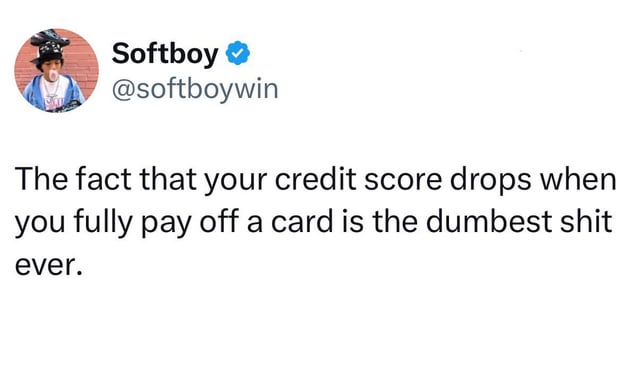
I think it’s important to mention why this is:
Your credit score is NOT a measure of just “how likely are you to pay off your debt”.
It is a measure of how likely you are to earn creditors money rather than lose them money.
Successfully keeping up with 4 monthly payments indicates you’re a likelier source of profit than only having one line of credit you pay each month. You likely have more expendable income, you’re more likely to pay interest instead of paying down extra principle, you’re clearly accustomed to carrying debt, etc.
This is a common misconception. Credit scores are actuarial risk, not profit utility. Having some debt load is a portion of that equation because it basically prevents dividing by zero. This is very basic actuarial science - you cannot produce a risk/utility metric without actually having priors, and within those priors there’s a concept of Fisher Information, which measures the likelihood that some sample of a random variable reflects true information about an unknown parameter. Simply put, the more information you have, the stronger the model. So the more debt you manage the more information about your debt management practices is available to the actuary. Up until the point that you have too much debt that it becomes very certain that you are high risk. If you have little credit history, but that history is perfect, you will still usually be in the lowest risk tier, but that might be like 780 instead of 850, or whatever, and that’s merely a reflection of certainly within the model, not your actual behavior. A person with similarly perfect behavior, and a lot more of it, should be intuitively seen as a lower risk.
I think it’s more accurate to say it’s a measure of risk , but it leads to the same result. Good, consistent repayment history means you are a known low risk. Without that consistent and recent history you are an unknown risk. Giving credit to low risk borrowers is where the profit is.
You’re missing their point.
If you pay off a loan, your credit score will likely decrease. Why would someone who’s able to pay off a loan be considered a higher risk than someone who pays $x a month to slowly pay down the same amount?
It’s absolutely about potential profit over risk. In the latter situation, the bank makes way more money.
It’s not just risk (negative income fot them), it is also the potential gain.
A guy that gets stuck in debt via overdraft all the time, but manages to scrounge just enough extra income to pay it off, is a gold-mine for them.
They are a higher risk because they no longer have an active demonstration of reoccurring on time payments.
I received a letter that my capital one credit card account was going to be closed because I haven’t used it in a year or two. They don’t like people who don’t use the cards or pay them off every month. It ends up costing them money
You’re correct about the late payers and minimum payment
20+% interest is legal loan shark
If that’s the case my debtless ass should have a much lower score. I’ve paid off a bunch of loans (mortgages, car, etc) and have <1% utilization now. Credit score just stays high.
There are many paths to earning profit for a credit issuer. Debt traps are one of the more predatory paths. Some credit issuers want to issue high rated bonds that provide low, but safe, income over a long period. Some don’t get profit from interest at all, high-end reward cards, for example. I haven’t paid a penny of credit card interest in decades yet I’m issued cards that provide me with over $20k in benefits every year, these companies make almost all of their money off swipe fees charged to the merchants and partnership deals.
It absolutely is “a measure of how likely are you to pay off your debt”, because that is “a measure of how likely you are to earn creditors money.”
It’s not some grand conspiracy. It’s a record of previous behavior to predict future behavior to determine if you fit their business model.