as a human you (most likely) have 3 types of photo receptors. Green, blue and red. That’s why digital pictures mostly use RGB to save color data. They save how much red light, how much green light and his much blue light each pixel should have. For this reason the sensors of digital cameras use the same pixels , just for capturing light instead. So the camera only captures Red,blue and green light from the visible spectrum and discards all else because we as humans can’t see that other light. But for scientific cameras, what the scientists look for might not be visible RGB light. So often the cameras capture ultraviolet light or other wavelengths instead. To display the image they have to shift the colors, because a) you can’t see ultraviolet light and b) your screen can’t display ultra violet light either. So they just transform to the RGB color space. What is blue in the image now is not blue in real live but actually ultraviolet. What is red is not red in real live but actually a different wavelength you can’t see.
This is true for basically all space images with long range telescopes like Hubble or James Webb. And for most satellites.



This is what they took from us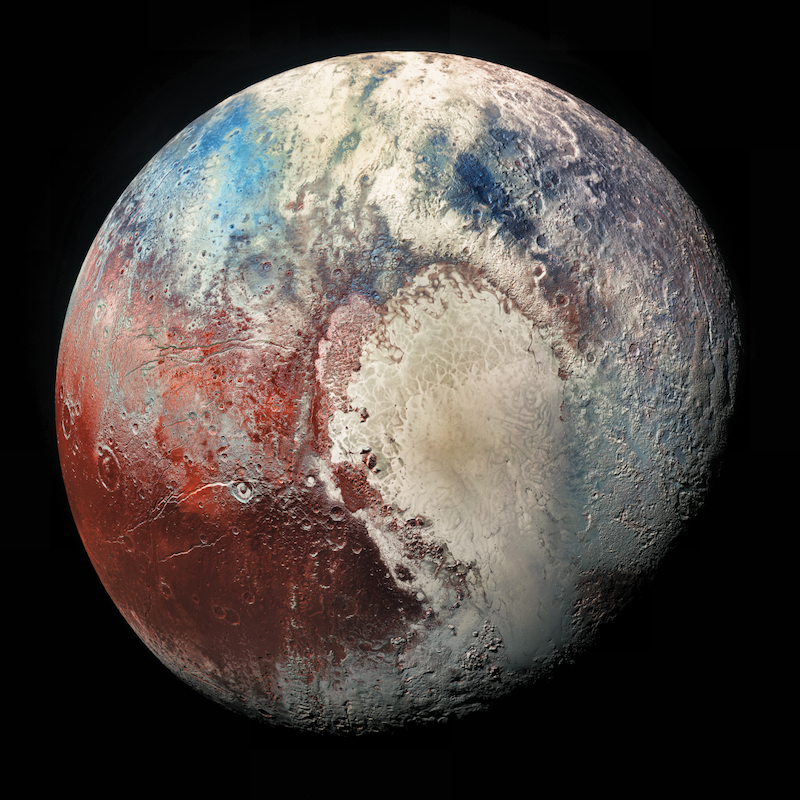
Pluto stole the attention back, not by name, but by best known of its class. Still the king.
However, Eris is more massive…
Its orbit is way more fucky than even that of Pluto tho.
(Actual colors not as depicted.)
Why are the colours different?
Cameras.
as a human you (most likely) have 3 types of photo receptors. Green, blue and red. That’s why digital pictures mostly use RGB to save color data. They save how much red light, how much green light and his much blue light each pixel should have. For this reason the sensors of digital cameras use the same pixels , just for capturing light instead. So the camera only captures Red,blue and green light from the visible spectrum and discards all else because we as humans can’t see that other light. But for scientific cameras, what the scientists look for might not be visible RGB light. So often the cameras capture ultraviolet light or other wavelengths instead. To display the image they have to shift the colors, because a) you can’t see ultraviolet light and b) your screen can’t display ultra violet light either. So they just transform to the RGB color space. What is blue in the image now is not blue in real live but actually ultraviolet. What is red is not red in real live but actually a different wavelength you can’t see.
This is true for basically all space images with long range telescopes like Hubble or James Webb. And for most satellites.
Interesting, thanks for the explanation
Maybe long exposure picture? (Guessing, I don’t know either)