And then you read the docs and it turns out to be something you already tried.
But now it works.
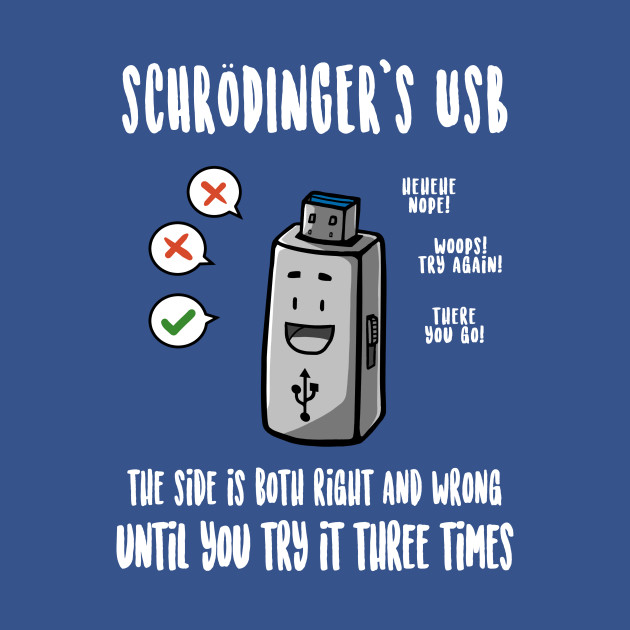
Like the USB superposition
It doesn’t work the first time but you copy paste from the docs example instead of typing the example and it works now
I’ve had times where I was going through my code and the docs code step by step to see where they logically differed and found that I was doing all the same things, but my code didn’t work and copy-pasting their code did. Make it make sense!
I find myself saying this about 35 times a day, at nearly every turn, with about everything I interact with.
Been there, found undefined behavior where there should not be any. Imagine a function that takes a bool param with the following code, but neither branch gets executed:
if (b)
   doStuffForTrue();
if (!b)
   doStuffForFalse();
In a function that is passed an uninitialized bool parameter, in gcc compiler, both branches can get executed even when b is const. Reason: uninitialized bool in gcc can have values of a random integer, and while if(b) {} else ({} is guaranteed to execute only one branch, bool evaluations of a bool value take a “shortcut” that only has defined behavior with an initialized bool.
Same code with an uninitialized integer works as expected, btw.
I had something similar to that with Power BI DAX where the same “intuitive” structure (a table definition) had different syntax for two similar purposes.
The inline table constructor for a single column table is
{value, value, ...}, with the column just named “value”. The constructor for a multi-column table is{(value, value, ...), (value, value, ...), ...}, and the columns are named “value1”, “value2” and so on.The function
DATATABLEallows both specifying the column names and types for the data. The syntax for the data argument is{{value, value, ...}, ...}.If you can spot the difference, you will have figured out why simply transplanting my constructor into a
DATATABLEdidn’t work, but copying an example and replacing the values one by one did. It took me way too long.Maybe you just missed some nuance your brain skipped over?
deleted by creator
I’m not sure there is a correct way to do this
That looks like an XY problem.
Finally, thanks I’ve been trying to remember the name of this for ages
Timtowtdi, doesn’t say there’s necessarily a correct one.
The funniest thing to me is that any good manual would just say “DO NOT USE SOCKS AND FLIP FLOPS SIMULTANEOUSLY”
What about tabi socks and setta?
what if i want to embarrass my nieces and nephews
Then you look back at your notes a couple years later and you’re like “I still don’t understand wtf I did it that way”.
It works, DON’T TOUCH IT.
The documentation is usually dog shit.
The corporate culture does not allow appropriate time for the documentation as it is considered something that cost money without a quantifiable gain.
It permeates in the FOSS space as well since writing good documentation is a skill and it is not fostered in corporations. So devs start great projects with terrible documentation.
One way to contribute to FOSS is to improve bad documentation. You are correct, of course, and lazy devs write bad code if they do not cultivate good documentation - imho.
Then they don’t learn the skill for themselves lmao, can’t win
Does anyone know of any good resources on writing good documentation? It’s a thing I’m weirdly passionate about and absolutely want to get better at for my own sanity and for others as well if I can contribute.
But it seems like it’s a very under discussed subject…
Veronica Explains has a really good video talking about how much of a dead skill it is now from the standards it used to be.
that does look less painful than reading documentation
then documentation instructs it must be used for spanking
Man page me daddy.
Hold on… Is it
flipflop -throw -f=10 -t=bor is itflipflop -throw 10 -f -b? The docs show both work for setting the force to 10 and target to buttocks
Then you pick up the manual:
To use, start using. If you get an error, try again
Reconfabulate the tridepodictaphone by nabulizing the fromgulan with kreevus. If stufingus brawes, then hyfangle the natriuminutaur.
Basic 17th year psycoders can do this.
It amazes me to see people do everything except 1) rtfm or 2) contact the support line that’s already paid for.
Edit: apparently my coworkers are in this thread.
As if the goddamn support knew their asses from their asserts.
The manual: poorly written; indecipherable
Support: reads the manual to you
“as viewed by the original dev who knows it inside and out”
That’s vibe coding.
I mean, thats how i learned to use a computer, was moms so the manual was gone by the time i used it anyway.
Joke’s on you, the docs don’t exist or are so outdated that they don’t even compile
Looking at you Microsoft.
I enjoy it more to figure out on my own. Kinda like disassembling stuff to see how it works and then put it back together. Reading the manual is like copying answers
The manual is probably outdated either way
Beat me to it.
What’s the meme for when the documentation is two years out of date?
Or when the documentation IS up to date… but the last 4 versions of the docs are still online and look exactly like the new version with no obvious sign of which version they are? (Looking at you, Microsoft)
And thereby learning more about what the program can do then the original dev even knew it could.
This is a weird picture of that important process though.